

A few years ago, most “image fraud” looked like low-effort Photoshop. Today, it often looks like a clean screenshot, a plausible invoice, or a photo that passes the quick glance test and spreads before anyone asks basic questions.
That shift matters because trust, once lost, rarely returns on schedule. It’s not only a PR problem. It becomes a support problem (tickets spike), a legal problem (claims and counterclaims), and a revenue problem (customers hesitate, partners pause, chargebacks creep up). For B2B brands, it can also become a procurement problem. Security reviews get tougher when you can’t explain how you spot manipulated media.
An AI image detector is not a shiny add-on. For many brands, it is becoming table stakes in the trust and safety stack, alongside identity verification, anti-fraud rules, abuse reporting, and human review.
The easiest attack is the one that looks ordinary
Bad actors rarely start with sophisticated deepfakes. They start with whatever gets them the result with the least resistance: a “proof” image that feels familiar.
A fake support chat is a good example. It does not require a face swap or a Hollywood-level edit. It requires a conversation that appears to show your company admitting fault, approving a refund, confirming an exception, or “promising” something you never promised. Tools like a fake whatsapp chat generator make it simple to produce convincing screenshots across many major platforms, not just WhatsApp but also Instagram, Slack, iMessage, Telegram, Teams, and more. Plenty of people use these tools harmlessly, for memes, storyboards, classroom examples, skits, even UX wireframes. But the same ease, templates, and platform-specific polish are exactly what attackers need.

fakechatgenerators.com lets you mock up chat screenshots across 16 platforms
From a trust and safety perspective, this is the uncomfortable truth: the content that causes the most damage often looks like the kind of content your users share every day.
Why this is now a business issue, not just a moderation issue
Trust and safety teams have been sounding the alarm for years, but the urgency has changed. Media manipulation is no longer a niche abuse type. It’s showing up in core business workflows:
- Customer support and dispute resolution: “Your agent told me X” with a screenshot attached. If your team cannot quickly assess authenticity, resolution slows, refunds rise, and the loudest bad-faith claim can set policy by exhaustion.
- Sales and partner relationships: Forged “proof” of endorsement, fake reseller agreements, doctored pricing pages. Even a small rumor can derail a deal in late stage procurement.
- Marketplaces and platforms: Listing photos, product documentation, proof-of-condition images, seller verification documents. If you can’t tell what’s synthetic or tampered, your risk model is flying blind.
- HR and internal security: Fake HR emails with “screenshots of prior approvals,” doctored performance evidence, altered documents in sensitive investigations.
The business consequence is not only the damage from the single incident. It’s the operational load that follows: escalations, manual reviews, back-and-forth, and inconsistent decisions. That inconsistency is where trust dies quietly.
Humans are good at context, and bad at volume
Most companies respond to manipulated images the same way they respond to any emerging abuse pattern: throw careful people at it.
That works until it doesn’t.
A trained reviewer can spot obvious telltales, mismatched fonts, weird cropping, inconsistent timestamps. But attackers do not need perfection. They need plausible. And the volume problem is brutal. When “proof” images arrive at scale, human review becomes a bottleneck that either delays legitimate users or forces you to accept more risk to keep operations moving.
An AI image detector does not replace human judgment. It triages. It flags. It gives reviewers a head start and gives your systems a signal to route cases intelligently.
What an AI image detector adds to your stack (in practical terms)
Think of an AI image detector as a decision-support layer. The value is not the existence of a model, it’s what you can do with the output:
- Automated risk scoring for inbound media
Every image that enters your system can be classified: AI-generated likelihood, signs of tampering, NSFW, violence. That score can feed into existing fraud rules, moderation queues, or case management systems.
- Faster, more consistent enforcement
When two reviewers look at the same “chat screenshot,” one may approve and one may reject. A standardized detection signal reduces those split decisions and gives policy teams something measurable to iterate on.
- Protection for customer-facing teams
Support agents should not be forced into forensic analysis. If your tooling can pre-label suspicious attachments, agents can handle disputes with more confidence and less escalation.
- Auditability and defensibility
When you take action against a user or deny a claim, you may need to explain why. A detector’s output, combined with internal logs, creates a more defensible narrative than “it looked fake.”
- Early warning for new abuse patterns
If you track detection rates by category (for instance, document tampering vs AI-generated photorealism), you can see what attackers are trying this month, not what they tried last quarter.
Why “AI-generated” is only half the problem
Many leaders hear “AI image detector” and think of Midjourney-style portraits or synthetic product photos. That is part of it, but it is not the only risk.
A strong trust and safety posture also cares about:
- Document tampering: altered invoices, edited IDs, modified shipping labels, doctored contracts.
- Context manipulation: authentic screenshots paired with misleading captions, or a real message cropped to hide critical context.
- Policy-sensitive media: NSFW and violence that can create brand safety issues, legal exposure, or platform policy violations.
In other words, the question is not only “Is this image generated by AI?” It’s also “Is this image safe, and is it honest?”
The operational case: latency and scale
Trust and safety is a real-time game. If detection is slow, teams will bypass it. If it adds friction to user flows, product leaders will fight it. So the operational characteristics matter.
This is where tools like an ai image detector are positioned as part of production workflows: detection across AI-generated media, NSFW content, violence, and document tampering, with claimed 98.7% accuracy across 50+ generative models (including Midjourney, DALL-E, Stable Diffusion, Flux, Ideogram, Google Gemini, and GANs) and sub-150ms latency. Those numbers are not just marketing copy, they point to whether you can run detection inline, at upload or intake, without turning your trust stack into a slowdown stack.
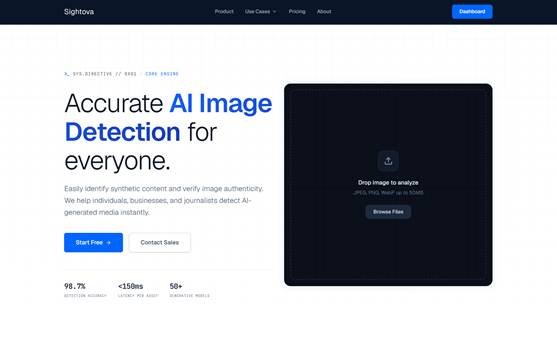
sightova.com flags AI-generated, tampered, NSFW, and violent imagery in milliseconds
If you’re evaluating vendors, latency is not a side detail. It is the difference between “we meant to” and “we actually did.”
Where it fits: a consultative map for buyers
Most brands already have pieces of a trust and safety stack. The question is how an image detector plugs in without creating another silo.
Here are common integration points:
1) User-generated content (UGC) pipelines
If you host uploads (profiles, listings, posts, messages), run detection at ingestion. Use the result to:
- block outright policy violations,
- queue borderline content for review,
- add friction (for example, “submit for review” instead of “publish now”) when risk is high.
2) Customer support attachments
Support is where a lot of fraud “evidence” shows up. Run detection when an attachment is uploaded to a ticket. Then:
- tag the ticket with a risk label,
- route high-risk tickets to specialized agents,
- standardize macros and response playbooks.
3) KYC, KYB, and compliance workflows
If you collect IDs, bank statements, business documents, or proof-of-address, document tampering detection becomes a force multiplier. It can reduce manual verification load and focus human review on the cases that truly need it.
4) Incident response and legal
When a manipulated image is spreading, comms and legal teams need fast triage. Detection signals help separate “likely synthetic” from “likely authentic but misused,” which changes what you do next.
A realistic threat model: the fake screenshot problem
If you want to convince internal stakeholders, stop describing the threat in abstract terms. Walk them through a scenario that feels like your business.
Example: A user posts a screenshot “showing” your brand approving a controversial claim. It starts on a niche forum, then moves to X and TikTok. Your social team sees it when it’s already a pile-on. Support gets thousands of angry tickets, many attaching the same screenshot as “proof.” Your agents cannot verify quickly, so responses vary. Someone offers compensation. Another denies. A third escalates. Now you have inconsistent public statements, internal confusion, and a screenshot that has become more “real” simply because it is everywhere.
An AI image detector helps in three places:
- Ingestion: flag the screenshot at upload, potentially limiting amplification on your own platforms.
- Triage: prioritize tickets with high-risk attachments and unify the response.
- Investigation: provide a consistent signal to inform comms and legal decisions.
It’s not magic. But it turns chaos into a workflow.
Buying guidance: questions that separate capability from claims
If you’re considering adding detection, the smartest move is to evaluate it like any other risk control: by coverage, performance, and fit.
A few questions worth asking:
- What categories do you actually need? AI-generated detection is useful, but do you also need NSFW, violence, and document tampering? Many companies discover too late they bought a narrow tool for a broad problem.
- What’s the latency in real production traffic? Sub-150ms is a useful benchmark if you need inline decisions. Ask how that holds under load and with your file types.
- How does it handle common real-world images? Screenshots, compressed JPEGs, heavily resized images, and images that have been re-shared through messaging apps.
- How are results returned? You want actionable outputs (scores, labels, confidence) that your systems can use, not a vague “yes/no.”
- What’s the workflow for appeals and false positives? Every automated control needs a human override path and a way to learn from mistakes.
- How quickly does it adapt to new generative models? Attackers iterate. Your controls need to keep up.
If a vendor can’t answer these cleanly, it’s a sign you’ll be doing a lot of manual glue work later.
The internal pitch: speak in cost, risk, and time
Trust and safety tools often struggle to get budget because the benefits are framed as vague “better safety.” The winning pitch is concrete:
- Time saved per case: even small reductions matter when you process thousands of tickets or uploads.
- Reduced escalation rates: fewer tickets bouncing to senior agents, fewer refunds granted to end arguments.
- Lower legal and reputational exposure: not as an abstract fear, but as a reduction in repeat incidents and faster resolution when incidents happen.
- Improved consistency: fewer policy exceptions created under pressure, fewer “we compensated once so we must compensate forever” traps.
If you can tie detection signals to existing KPIs, you will stop arguing about whether the problem is “real” and start discussing implementation.
Trust is built in quiet moments
Most brand damage doesn’t come from a single viral event. It comes from customers noticing that your systems are easy to manipulate, that disputes are handled inconsistently, that bad actors seem to have a playbook you can’t match.
An AI image detector is one of those controls that customers may never see. That’s fine. Seatbelts are like that too.
What matters is the moment you do need it, when a convincing fake is headed for your support queue, your marketplace, your verification workflow, or your news cycle. At that point, the question is not whether manipulated media exists. The question is whether your brand can respond faster than it spreads.